- E-ISSN: 16840348
-
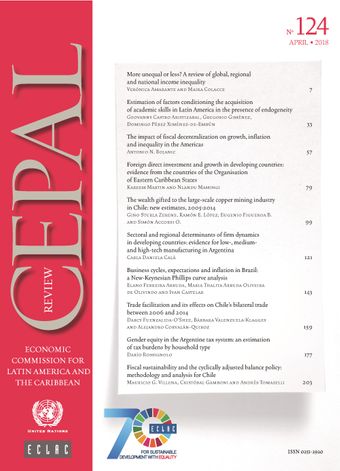
Business cycles, expectations and inflation in Brazil: A New-Keynesian Phillips curve analysis
- Source: CEPAL Review, Volume 2018, Issue 124, Oct 2018, p. 143 - 158
- Spanish
-
- 04 Oct 2018
Abstract
This article analyses Brazil’s recent inflation dynamic, considering different expectations environments within the New-Keynesian Phillips curve framework, to observe how the potential for discretionary behaviour by the monetary authority can interfere in economic agents’ forward-looking expectations, and how that interference can affect the way inflation responds to its inertial component and to business-cycle fluctuations. To that end, the study estimates the New-Keynesian Phillips curve and its hybrid version, using the heteroscedasticity-and-autocorrelation-consistent (HAC) estimator of the generalized method of moments (GMM). The results suggest that, when economic agents possess lower degrees of foresight, inflation will be more sensitive to business-cycle fluctuations the larger is its inertial component. Keywords