- E-ISSN: 16840348
-
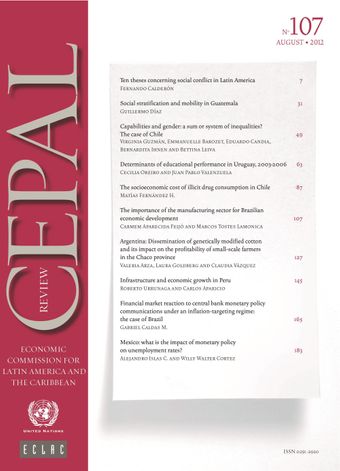
Determinants of educational performance in Uruguay, 2003-2006
- Source: CEPAL Review, Volume 2012, Issue 107, sept. 2012, p. 63 - 86
- Espagnol
-
- 18 sept. 2012
Abstract
Students’ performance at the lower secondary level in Uruguay is examined on the basis of the mathematics scores compiled by the Programme for International Student Assessment (pisa) for 2003 and 2006. An effort is made to analyse the differences in score distributions, to identify the variables influencing students’ performance and to trace the trends over that period and weigh their significance. In order to do so, a production function for educational achievement is defined and a number of different decomposition methodologies are applied. The findings indicate that the small increase in scores between 2003 and 2006 is the net result of differing changes, most of which are primarily the result of an across-the-board increase in the school system’s efficiency, especially in the case of public schools. However, this improvement is partially offset by reduced resource endowments and, in particular, unfavourable socioeconomic and cultural conditions in many of the students’ households. Most of the changes that are analysed in this study are found to be of a redistributive nature.