


World Heritage Review - Volume 2021, Issue 98, 2021
Volume 2021, Issue 98, 2021
-
-
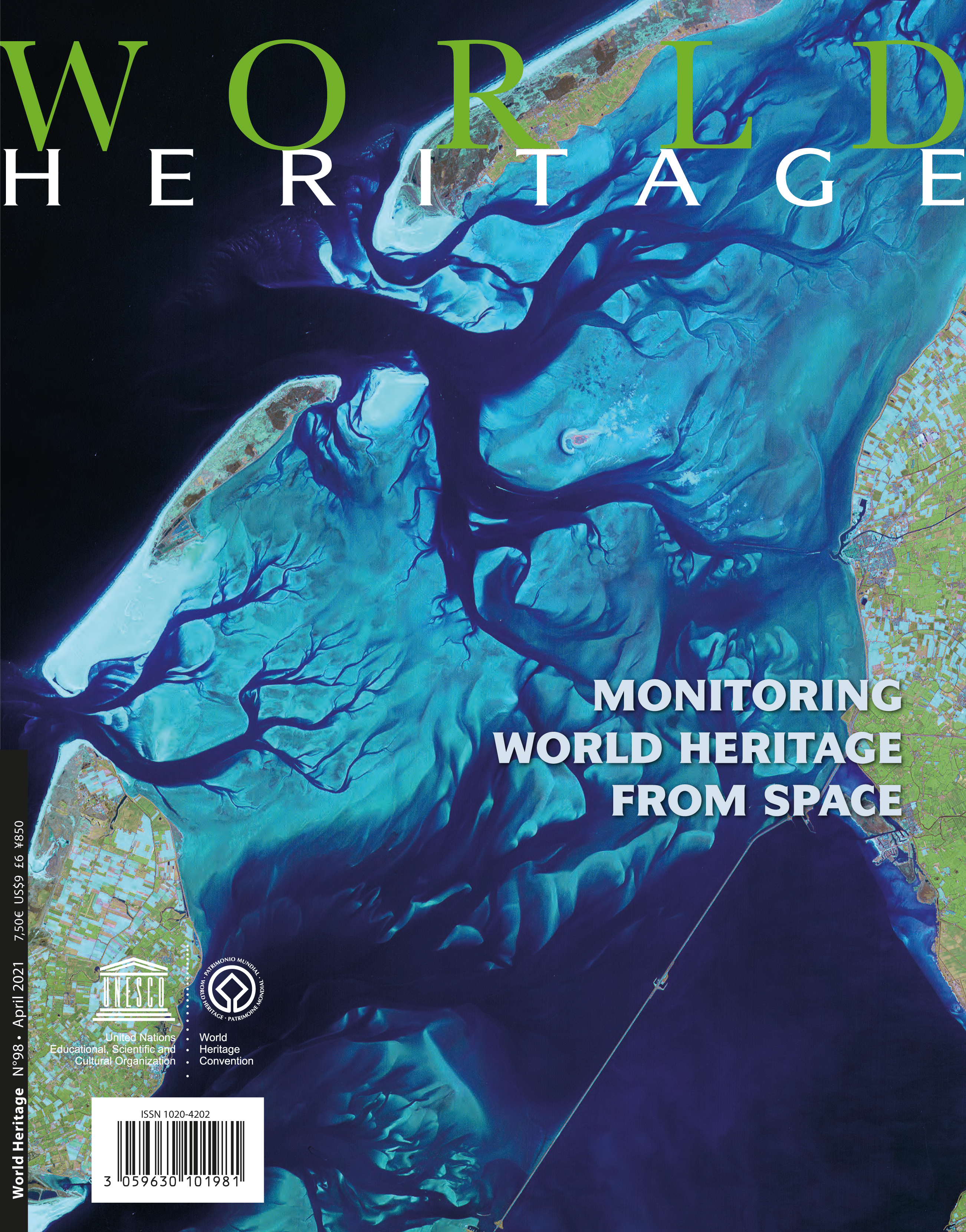
In Focus: Travelling through space and time: Remote sensing of natural World Heritage sites
More LessAuthors: Dr Shirish Ravan, Dr Gautam Talukdar, Dr Anukul Nath and Abhineet JainHumankind has already been using Earth observation satellites as a tool for over 50 years, and observation data archives provide valuable information to fill in the gap due to lack of documentation and statistical records in the past. For example, the Earth observation data archives are available to the public right from the earliest images taken from 1960 to 1984 by the very first USA photoreconnaissance satellite CORONA, to the data acquired today by the latest satellite constellations. Recognizing the socio-economic value of this information, several satellite data providers are offering open access to their archives, which makes it possible to monitor natural and cultural heritage sites and assess their condition. As countries are relaxing their policies towards the use of drones, collecting aerial images is coming within everyone’s reach and would complement the Earth observation data collected from space.
-
-
-
Space Technologies for Heritage: Two case studies
More LessAuthor: Meng WangContemporary global challenges such as climate change, natural disasters, deforestation, overexploitation of natural resources, pollution and urbanization, among others, are complicating efforts for the protection of World Heritage sites. Ensuring sustainable development of these sites therefore requires improvements in our approaches to monitor and manage these valuable places. In this context, space technologies provide monitoring capabilities that allow World Heritage management authorities access to timely, objective and accurate information, enabling them to promptly assess risk and devise an appropriate response to mitigate them. To facilitate adoption of space technology for World Heritage monitoring, the International Centre on Space Technologies for Natural and Cultural Heritage (HIST), a category-II Center under the auspices of UNESCO, was officially established by the Chinese Academy of Sciences (CAS) in July 2011, following the decision of UNESCO’s General Conference at its 35th session in 2009.
-
-
-
Damage assessment on World Heritage sites by UNOSAT
More LessAuthor: Camille ChambinaudFor the past twenty years, UNOSAT has been developing its expertise in using Geospatial Information Technologies to promote evidence-based decision-making for peace, security and resilience. UNOSAT was created in 2001 to support Member States, UN agencies, NGOs and international organizations. As an operational programme of the UN Institute for Training and Research (UNITAR), it provides coordinated geospatial analysis and develops capacities for geo-information technology to further the achievement of the SDGs. This includes documenting and raising awareness on the devastating impact hazards and conflicts can have on our World Heritage, and showing how geospatial information technologies and data can support efforts to preserve both cultural and natural sites.
-
-
-
Mapping land cover dynamics with Copernicus
More LessAuthor: Andreas BrinkSub-Saharan Africa has known unprecedented land cover and land use changes over the past decades, affecting species abundance and distribution and altering ecosystem productivity (Sala, 2000; Pfeifer et al., 2012). The main drivers of these changes are both human and natural, including a high rate of population growth, economic development and globalization on one side and hazards such as drought and climate change on the other (Brink and Eva, 2009). In this context, protected areas (PAs) are vital for conserving natural habitats and their species; moreover, they are critical for meeting global conservation targets defined under the Convention on Biological Diversity and the Sustainable Development Goals.
-
-
-
Close-Up: UNOSAT reveals damage to Syria’s cultural heritage
More LessAuthors: Manuel Fiol, Alejandra Arango, Maamoun Abdulkarim and Ruba KasmoAn upcoming UNESCO-UNITAR publication – Ten years of conflict, the state of cultural heritage in Syria – will assess, through satellite images, the destruction the Syrian conflict has inflicted to date on the country’s cultural heritage.
-
-
-
Advisory Bodies
More LessAuthor: Andreas GeorgopoulosEver since humans have felt the need to survey what was happening in the environment around them, a higher vantage point has been considered useful. Trees, hills and mountains served this purpose until humans were able to ‘fly’. Balloons, airplanes and later satellites offered observation platforms that enabled a more general and complete perception of the earth’s surface. The need for such a view was initially driven by military purposes, but other applications have also greatly exploited the possibilities.
-
-
-
Conventions
More LessIn 1946, when the International Whaling Commission (IWC) was created, who could have believed that whale research would ever be conducted from space? But today, as the IWC celebrates 75 years of cetacean science and conservation, electronic tagging and very high resolution (VHR) satellite imagery are increasingly important ways to study whales. The information gathered is put to work in the development of conservation strategies and protection of healthy habitats around the globe, including in a number of World Heritage sites.
-
-
-
News: Preservation
More LessSpread across 37 nations from the tropics to the poles, the 50 UNESCO marine World Heritage sites are among the ocean’s most productive waters. Their abundance of marine life is vital to sustain the livelihoods of indigenous communities, local businesses and artists alike.
-
-
-
In Danger
More LessAlmost a decade after the mausoleums in the UNESCO World Heritage site of Timbuktu were destroyed by extremists, the International Criminal Court (ICC) has awarded a symbolic one euro to the Government of Mali and to UNESCO, in recognition of the damage suffered by the Malian people and the international community due to the loss of Timbuktu’s cultural property.
-
-
-
Outreach
More LessThe World Heritage Volunteers Initiative has announced the results of its Banner and T-Shirt Design Competition. Launched in 2020, it aimed to find a global shared visual identity for the World Heritage Volunteers 2020-2021 campaign, while celebrating the creativity of the participating organizations that enable the Initiative’s success year after year.
-
Volumes & issues
Most Read This Month
