- E-ISSN: 16840348
-
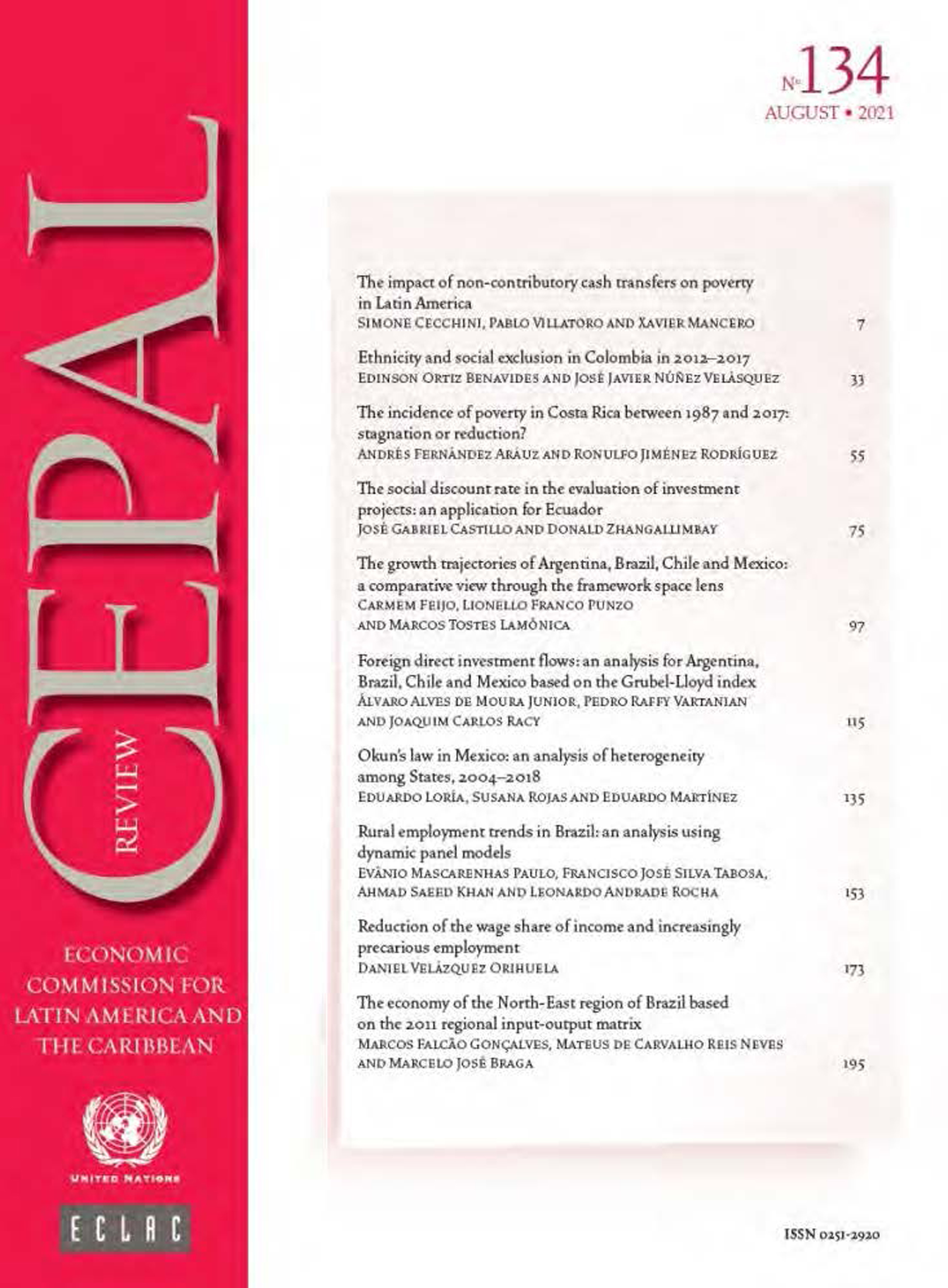
The social discount rate in the evaluation of investment projects: an application for Ecuador
- Source: CEPAL Review, Volume 2021, Issue 134, Feb 2022, p. 75 - 95
- Spanish
-
- 16 Feb 2022
Abstract
The standard social discount rate of 12% applied by planning institutions and multilateral agencies when evaluating public projects is a constant administrative parameter that is unsupported and unresponsive to changes in social preferences over time. This paper presents an alternative way of determining the social discount rate based on the gamma estimation model (Weitzman, 2001) in a developing-country context, which has three advantages: (i) it incorporates decreasing discounting, (ii) it is cost-efficient in that it sums up the various expert opinions and (iii) it adjusts for changes in short- and long-term preferences. Our estimates are lower than the standard nominal rate for different time periods, ranging from 2% for evaluation horizons longer than 51 years to 11% for the short term (0–5 years).