- E-ISSN: 16840348
-
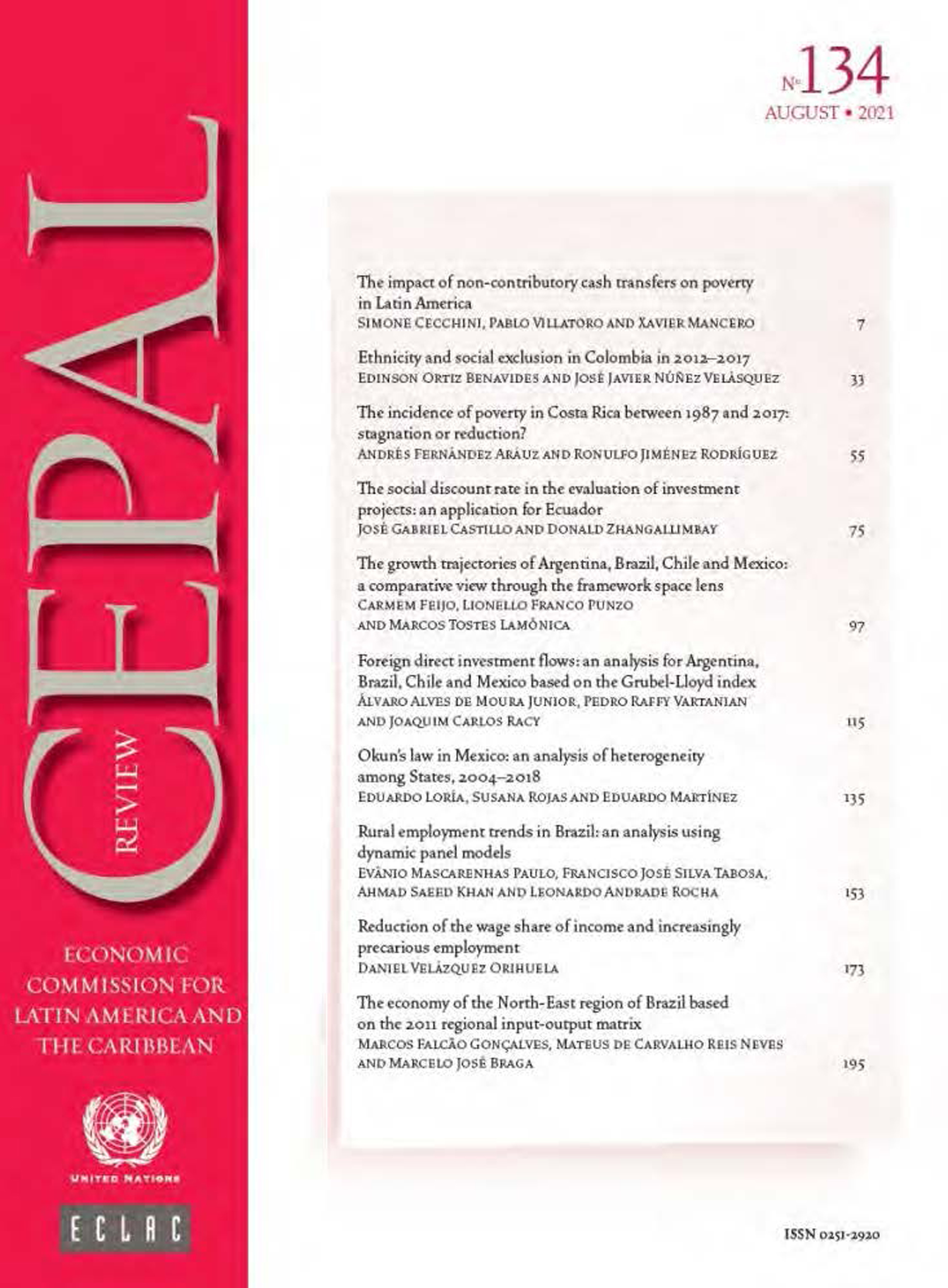
The growth trajectories of Argentina, Brazil, Chile and Mexico: a comparative view through the framework space lens
- Source: CEPAL Review, Volume 2021, Issue 134, Feb 2022, p. 97 - 114
- Spanish
-
- 16 Feb 2022
Abstract
This paper discusses different growth trajectories in a selection of Latin American economies, namely Argentina, Brazil, Chile and Mexico, comparing the phase of import substitution growth strategies with the more recent period of financial integration into the world economy. Our working hypothesis is that different growth trajectories result from the linkages between macroeconomic conditions and changes in production structures. When policy space becomes narrower, long-term growth performance is impaired and structural change will not usually enhance growth potential. We carry out an analysis based on the framework space methodology, which serves to compare phases of growth described as an evolving coupling of the dynamic profile of productivity growth (a supply-side condition) with the behaviour of capital accumulation (a demand-side condition). In light of the framework space comparative analysis, our main conclusion is that economic opening in the 1990s did nothing to further the catching-up process in any of the four economies.