- E-ISSN: 16840348
-
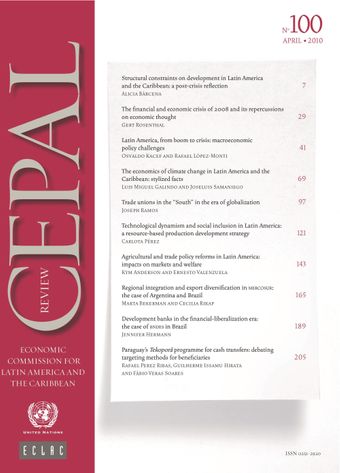
The financial and economic crisis of 2008 and its repercussions on economic thought
- Source: CEPAL Review, Volume 2010, Issue 100, Apr 2010, p. 29 - 39
- Spanish
-
- 24 Apr 2010
Abstract
The financial and economic crisis of 2008 had multiple consequences in Latin American and Caribbean countries. It disrupted economic performance and called into question the paradigms that had steered economic policy in most countries; and it also exacerbated the growing divergences in points of view that were emerging before the crisis, some of which are ideological, while others reflect different approaches to economic strategies. The differentiating factors include: the role of the State and its relation to the market; and the nature and scope of participation in the global economy. This article addresses some of these divergences, the tensions they generate, and what the future holds for cooperation within Latin America. It also points out that in this new scenario, characterized by some perplexity, issues inherent to the work of ECLAC are clearly emerging.