- E-ISSN: 16840348
-
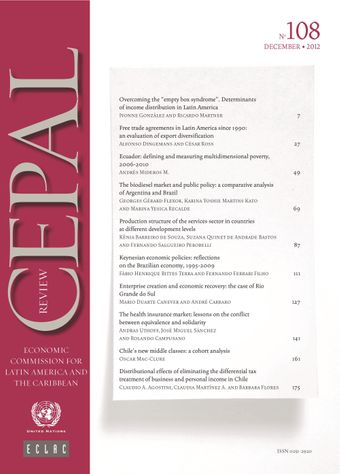
Distributional effects of eliminating the differential tax treatment of business and personal income in Chile
- Source: CEPAL Review, Volume 2012, Issue 108, Dec 2012, p. 175 - 201
- Spanish
-
- 27 Dec 2012
Abstract
This paper estimates the distributional effects that would result from eliminating the differential tax treatment of business and personal income in the Chilean tax system, as well as from the elimination of the main personal income tax exemption, the one for voluntary retirement savings. The results of the analysis show that, while the majority of taxpayers benefitting from this exemption are in the upper income brackets, its elimination would not make the income tax more progressive. As to removing the favourable tax treatment for corporate income, the distributional effect is of relevant magnitude and the income tax becomes significantly more progressive. Generally speaking, the results suggest that income taxation in Chile is less progressive than it appears and that it is feasible to give it a more important redistributional role in reducing income inequality.